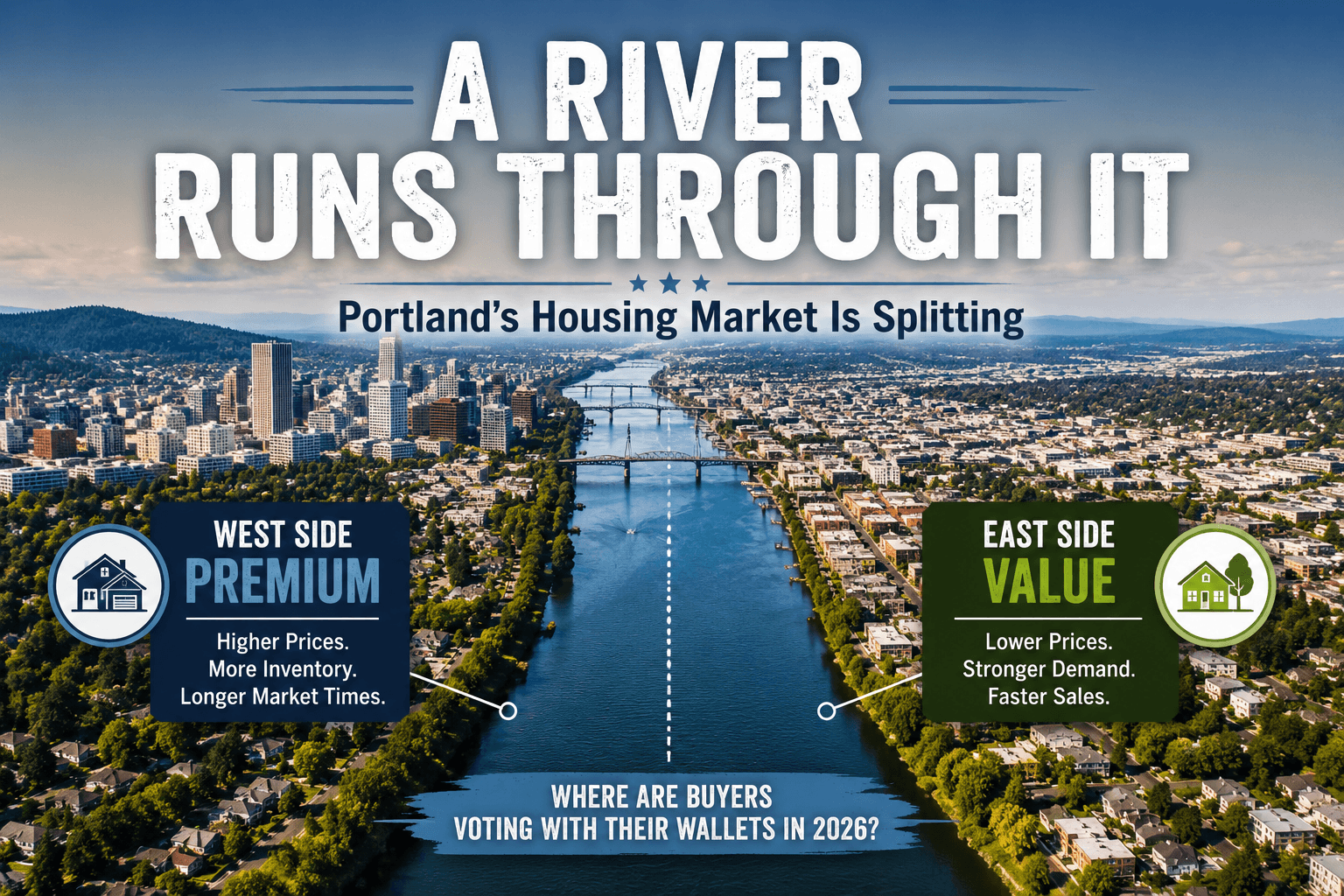
A River Runs Through It: Portland's Housing Market Is Splitting
For years, the rule was simple: west side = higher demand, faster appreciation, stronger pricing. East side = affordability play. But 2026 RMLS data is starting to blur that line. I dug into the numbers, and a clear shift is emerging in buyer behavior across the metro.
For years, Portland real estate followed a fairly predictable script.
Generally speaking and some exceptions to the rule, if you could afford the west side, you bought on the west side. If you couldn't, you looked east.
That wasn't always true, of course, but it was close enough that most Realtors, lenders, and homeowners understood the general pecking order.
The latest RMLS Market Action Reports suggest that script may be changing.
As I dug through the numbers, one trend became impossible to ignore: buyers are showing stronger enthusiasm for many east-side communities than we've seen in years, while several west-side markets are taking longer to absorb inventory and attract offers.
Before anyone in Lake Oswego or in the West Hills starts drafting an angry email towards me, let's be clear: this isn't a story about the west side struggling.
It's a story about buyers becoming more value-conscious.
And that matters. And it’s showing in what buyers are willing to pay.
For years, buyers simply accepted that west-side homes would appreciate faster because demand would always be stronger. So far this year, the RMLS numbers suggest that assumption deserves a second look.
Several major west-side markets are now showing declining average sale prices over the past 12 months. Average sale price in NW Washington County is down 6.7%, Tigard/Wilsonville is down 2.6%, Hillsboro/Forest Grove is down 2.6%, and Beaverton/Aloha is down 1.3%. Meanwhile, West Portland itself has essentially gone sideways. In contrast, North Portland, Northeast Portland, Southeast Portland, and Oregon City/Canby all posted positive price growth.
That doesn't mean west-side real estate is in trouble.
It means buyers have become far more disciplined.
For much of the last decade, buyers were willing to pay almost any premium for the "right" ZIP code. In 2026, buyers have relearned how to do math.
When buyers can save hundreds of thousands of dollars by crossing a river, many are deciding that a slightly longer commute—or a commute they only make twice a week—is a trade worth making.
The result is exactly what economics would predict: stronger demand, faster sales, and firmer pricing in many value-oriented markets, while some higher-priced areas face increased competition and greater pressure on pricing.
That said, a better way to measure buyer demand isn't always by looking at prices. It's by looking at pending sales—because buyers vote with purchase agreements, not statistics.
Through the first five months of 2026, pending sales increased 14.1% in Northeast Portland, 15.0% in Milwaukie/Clackamas, 9.7% in Oregon City/Canby, and 6.2% in Gresham/Troutdale compared to the same period last year.
Meanwhile, Tigard/Wilsonville saw pending sales decline 2.3%, while Hillsboro/Forest Grove managed just a 1.0% increase. West Portland (essentially made up of the West Hills) posted a respectable 7.8% increase, but it wasn't enough to clearly outperform many east-side markets.
The market-time statistics tell an even more interesting story.
InMay, homes in SE Portland averaged just 33 days on market before accepting an offer. Northeast Portland averaged 40 days and North Portland averaged 43 days.
On the west side (cue the Price is Right zonk sound effect), West Portland averaged 75 days, Hillsboro/Forest Grove averaged 67 days, Beaverton/Aloha averaged 65 days, and Lake Oswego/West Linn averaged 61 days.
In other words, buyers are still buying. They're just taking longer to pull the trigger when the price tag gets bigger.
And honestly, that makes perfect sense.
Mortgage rates remain above 6%. Affordability hasn't disappeared as a concern simply because we've gotten used to talking about it.
The median sale price in Southeast Portland was $535,000 in May. Northeast Portland came in at $550,000. Compare that to NW Washington County at $716,600, Tigard/Wilsonville at $622,000 or the upper income neighborhoods of West Portland at $745,000 and Lake Oswego/West Linn at $905,600.
That gap translates into hundreds—sometimes thousands—of dollars per month in payment difference.
A few years ago, buyers might have stretched to make that work (because of lower rates, it wasn’t a Gumby level stretch – it was more of a mid-day nap level of stretch). Today, many are asking a different question: "Do I really want a bigger mortgage, or do I want a little more financial breathing room?"
The inventory numbers suggest many buyers are choosing the latter.
West Portland currently has 1,013 active listings. Southeast Portland has 589. Yet West Portland recorded only 250 pending sales in May compared to Southeast Portland's 285.
That's a meaningful shift in leverage.
Sellers on the west side increasingly find themselves competing against a larger number of similar homes, while east-side sellers often face a smaller pool of competition.
What's especially interesting is that East of the Willamette River is behaving differently than much of the country.
National housing reports released this week showed new listings declining and buyer activity softening in many markets as affordability challenges, Iran, inflation, the rate bump that started at the beginning of the Iran situation, and economic uncertainty continue to weigh on consumers.
Yet East of the Willamette continues to show signs of resilience.
Portland is not a market in retreat. It’s essentially a 2 tales of one metro area. I’m betting if there is someone that is able to look inside of the metro area for cities like San Diego, Riverside County, San Francisco, Oakland, Sacramento – you’ll see similar statistics. You just need to find a fellow nerd in those cities to dissect the data as I have here in Portland.
This market is recalibrating.
For years, buyers chased geography. In 2026, they're chasing value.
The Willamette River still divides Portland geographically. Increasingly, it also appears to divide two different housing stories: one where buyers are paying a premium for location, and another where they're finding affordability, competition, and opportunity.
And at least so far this year, opportunity seems to be winning more often than many people expected.
#PortlandHousingMarket
#OregonRealEstate
#RMLS#HousingMarketTrends
#RealEstateTrends2026
#WestVsEastPortland
#WillametteValley
#PortlandHomes
#HomePrices
#HousingAffordability
#MortgageRates
#RealEstateData
#MarketAnalysis
#HousingShift
#BuyersMarket
#RealEstateInsights
#PacificNorthwestRealEstate
#PortlandRealtor
#HousingEconomics