
You Can Refinance Your Rate.
You Can't Refinance the Price You Paid
Stop Waiting for Lower Mortgage Rates. Start Watching Home Prices.
There is an old Warren Buffett quote that I've always loved:
“Be fearful when others are greedy and greedy only when others are fearful.”
Buffett was talking about investing in stocks when he wrote that in Berkshire Hathaway's 2004 shareholder letter. I think the same concept applies remarkably well to today's housing market.
For the last few years, potential homebuyers have been obsessed with one number: mortgage rates.
When will rates come down? Should I wait until they're back in the 5s? What if they get back to 4%? Should I just sit on the sidelines until borrowing money gets cheaper?
Those are reasonable questions. Monthly cash flow is at the heart of that question. There is about to be an opportunity to have a lower monthly payment even though we are in an elevated rate environment. PLEASE stay with me. This article isn’t about a temporary buydown of rate, or some mortgage tactic. It’s about the macro-economic temperament of the Portland Metro area as we head into receiving 3 feet of rain over the next 6 months.
I think buyers may be watching the wrong number. Why? Everyone is waiting for mortgage rates to go “on sale”, Portland houses are about to go on sale instead.
Let's Talk About 10.52%. Don’t worry, it’s not a mortgage rate.
If you've read any of my economic ramblings before, you know that I have a tendency to nerd out over numbers. It's a character flaw I've learned to embrace.
Here's today's number: 10.52%.
In my August presentation to Emily Corning's team at Hustle & Heart Homes, I highlighted something that happened in the Portland housing market last year. The RMLS median sales price fell from $570,000 during the summer to $510,000 during the winter.
That's a $60,000 drop—or 10.52%.
What caused it? Politics, obviously. Trump? Or was it Biden? Kotek? Kidding. 😊
Maybe mortgage rates skyrocketed? Nope! In fact, in July 2025, Freddie Mac's weekly survey had 30-year mortgage rates hovering around 6.7%. By February 2026, they were roughly 6.0%. Mortgage rates actually fell while Portland home prices were falling.
So what happened? Something considerably less exciting.
It rained. Welcome to Portland.
Seasonality is one of the most underappreciated forces in real estate. Families like moving during summer. Kids are out of school. The days are long. Flowers are blooming. The backyard looks fantastic.
Then October arrives. School is underway. The sun begins setting sometime shortly after lunch. Your lawn turns into something resembling a federally protected wetland, and you haven't seen Mount Hood in three weeks while the Oregon Ducks Football team continues to put hope in your heart, only to steal it again like an ex-girl friend that you can’t seem to permanently break up with.
Suddenly, spending Saturday touring eight houses doesn't sound quite as appealing. Especially after that Oklahoma State loss. Yowzah!!!
Fewer buyers means less competition. Less competition means homes sit longer. Homes sitting longer means sellers become more willing to negotiate. The long-term 10 year RMLS data shows that seasonal sawtooth repeating over and over. Prices generally strengthen into spring and summer and soften as we head toward winter.
Does that mean Portland home prices are guaranteed to decline exactly 10.52% again? Of course not. In this environment, I’d say there is a likelihood that it might be more as we head into the early parts of 2027.
This year, I think buyers should be paying very close attention.
Here's where Buffett's quote becomes relevant.
Think about the psychology of today's buyer. Rates are high. Affordability is challenging. Headlines aren't particularly cheerful. Buyers are nervous.
So they wait. But imagine mortgage rates suddenly fall substantially.
The buyer waiting at 6.5% notices… So does the buyer waiting at 6%... So does the buyer waiting at 5.5%.
Suddenly, many of the people sitting on the sidelines start shopping at the same time. That's great if you already own the house. I'm not convinced it's great if you're trying to buy it. More buyers can mean more competition, fewer seller concessions and upward pressure on prices. You finally get the mortgage rate you wanted—but everyone else shows up to the sale with you.
I'd rather shop when the parking lot is empty.
The Math Most Buyers Aren't Doing: Here's where this gets really interesting (and I think where a lot of you respect my nerdery). Let's take last year's Portland numbers and exaggerate the interest-rate disadvantage just to make the point.
Buyer A purchases a home for $570,000 with 20% down and gets a 6.00% 30-year fixed mortgage.
Buyer B waits for the seasonal opportunity, buys the comparable home for $510,000, but let's punish Buyer B with an interest rate that's a full percentage point higher: 7.00%.
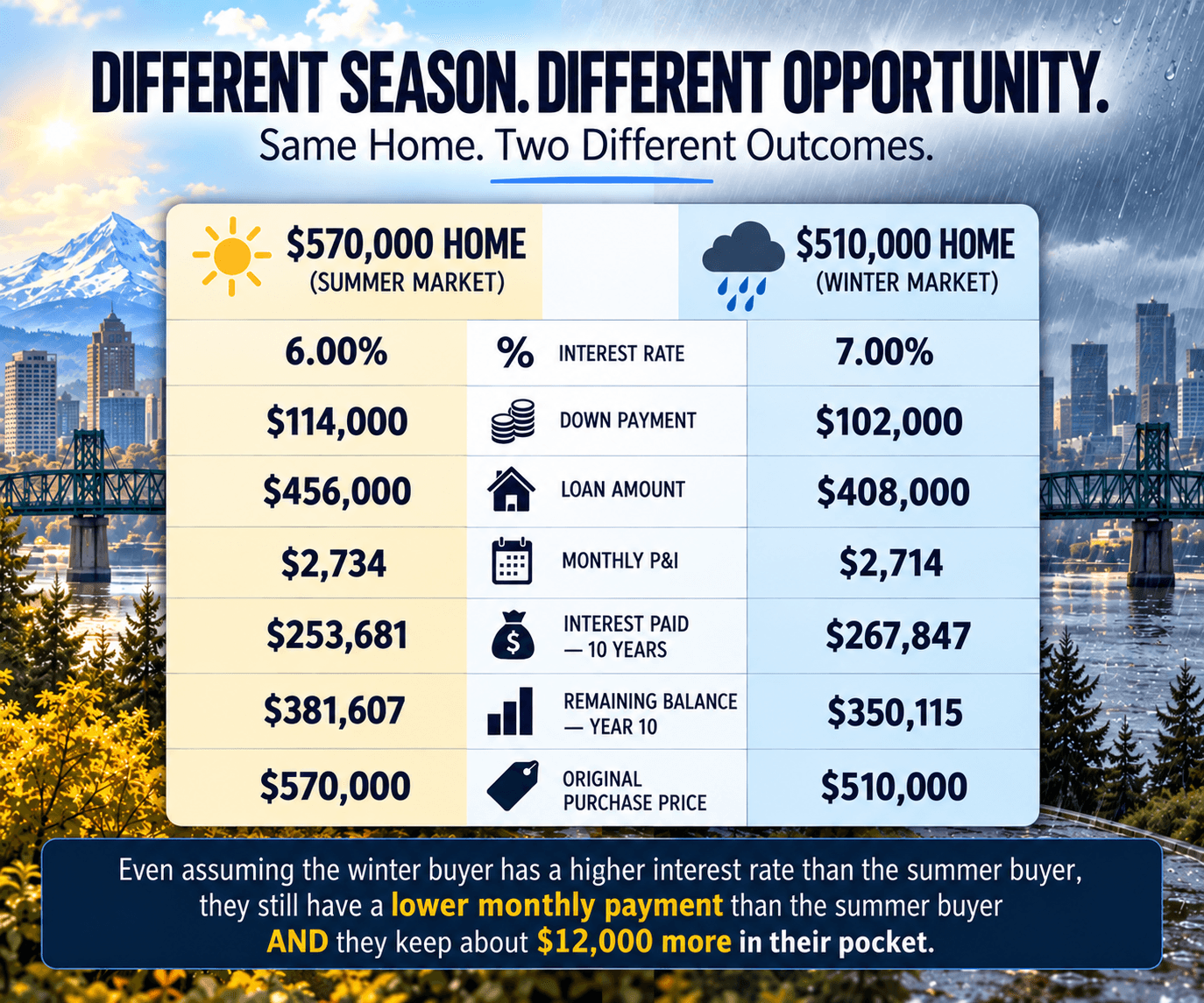
Yes, you read that correctly.
The person paying 7% has a lower mortgage payment than the person paying 6%.
Why? Because price matters.
The cheaper-home buyer borrowed $48,000 less and brought $12,000 less to closing. Over the first ten years, the higher interest rate costs that buyer approximately $14,166 in additional interest.
But they paid $60,000 less for the house. They also kept $12,000 of their cash instead of putting it into the down payment.
You can refinance an interest rate. You cannot refinance what you paid for the house. And my example doesn't assume Buyer B ever refinances. I deliberately leave them stuck at 7% for the entire ten years. If rates fall later and they refinance? The math potentially gets even better.
There's Another Person at the Negotiating Table. The seller.
American homeowners have accumulated enormous amounts of equity. The Federal Reserve data I included in my August presentation showed owners' equity at more than 70% of household residential real-estate value.
That changes seller behavior.
Someone who bought their house 15 years ago may be sitting on hundreds of thousands of dollars of equity. If their house doesn't sell immediately, they may have room to reduce the price, contribute toward closing costs or pay for a temporary interest-rate buydown.
As I've described it before, homeowners have won the previous 20 hands of blackjack. Losing a hand or two doesn't mean they're leaving the casino broke.
They're still leaving a winner. And that creates negotiating opportunities for buyers.
The Opportunity Nobody Is Waiting For:
I don't know exactly where Portland home prices will bottom this winter. Nobody does.
I don't know exactly where mortgage rates will be in February, either. But I do know something about human behavior. People like buying things when everybody else wants them.
Housing isn't any different.
Which brings me back to Buffett. Being greedy when others are fearful doesn't mean recklessly buying something simply because its price fell. It means recognizing that fear can create opportunities that disappear when confidence returns.
So while everyone else is waiting for the perfect mortgage rate, I'll be watching something else:
· Inventory.
· Days on market.
· Price reductions.
· Seller credits.
… and Portland's wonderfully miserable winter weather.
Because the best time to negotiate on a house probably isn't a sunny Saturday in May when three other families are standing in the kitchen discussing where they're going to put their couch.
It might be a 44-degree Saturday in January, when it's raining sideways, the house has been sitting on the market for 87 days, the seller has already reduced the price twice, and you're the only person who showed up.
That's when I want to go shopping.
#PortlandRealEstate #PortlandHousing #PDXRealEstate #OregonRealEstate #PortlandOregon #HousingMarket #RealEstateMarket #MortgageRates #HomePrices #HomeBuying #Mortgage #RealEstate #HousingEconomics #EconomicOutlook #MortgageBroker #weather #BrokersAreBetter C2 Financial