When Bombs Drop in Iran, Mortgage Rates Rise in the United States
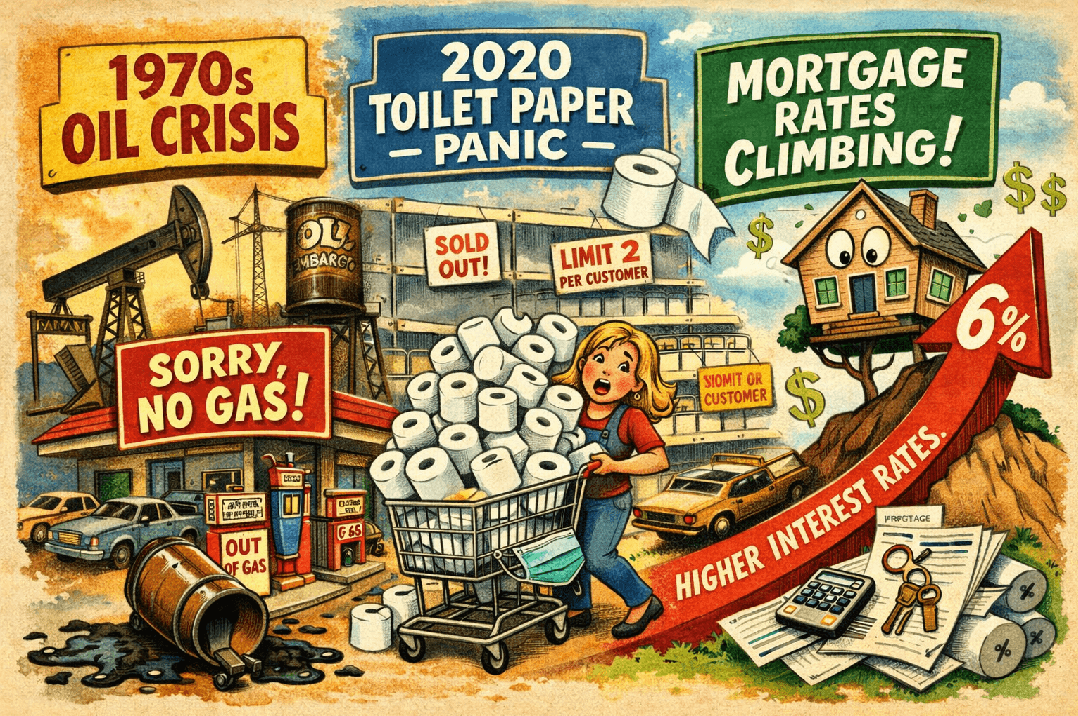
From 1970s gas lines to COVID toilet paper panic — here’s why mortgage rates jumped this week!
When news broke last Saturday that the United States had begun bombing targets in Iran, many people expected the financial markets to behave in a very predictable way when trading opened Monday morning.
The common assumption went something like this:
- Stocks fall (because war is scary, and investors take money out of the market).
- Investors run to the safety of bonds.
- Bond prices then fall because issuers don’t have to offer as high of a return.
- Mortgage rates then follow suit.
Simple. Clean. Textbook.
Except… that’s not what happened.
Stocks did fall, which made sense. But instead of bonds rallying, the bond market actuallysold off, pushing mortgage rates higher and sending the average 30-year mortgage backover the psychological 6% lineafter briefly dipping below it the previous week.
For mortgage nerds (my people), that was a bit of a head scratcher.
Before we go further, let me say something I try to remind readers of often: when I write these updates, I’m not coming at them from thered side or the blue sideof politics.
I try to staygreen — the color of money. Markets don’t vote. They react. And sometimes they react in ways that surprise everyone.
Oil Is Usually the First Domino
Whenever conflict breaks out in the Middle East, traders immediately start staring at one place on the map: the Strait of Hormuz.
That narrow shipping lane carries roughly20% of the world’s oil supply. If tankers stop moving through it, the global economy suddenly has a caffeine shortage — and oil is the caffeine. Markets reacted quickly this week. Oil prices jumped as traders priced in the possibility that supply disruptions could occur if the conflict spreads.
And here’s the key point:
Higher oil prices = higher inflation expectations.
When inflation expectations rise, the bond market gets nervous. Why? Because inflation is kryptonite to bonds.
If inflation is expected to run hotter, investors demandhigher yieldsto compensate. That pushes bond prices down and yields up — which ultimately translates into higher mortgage rates.
So instead of a classic “flight to safety,” the market’s first reaction was something more like this: “War might mean expensive oil… expensive oil means inflation… inflation means bonds need higher yields.”
Cue the bond sell-off.
The Second Domino: Government Debt
There’s another layer to this story that bond traders are also thinking about. The U.S. government already needs to issue a significant amount of Treasury debt to fund spending — including the recently passedBig Beautiful Bill.
Now add a potential military conflict into the mix. Wars have a funny habit of costing money. Lots of it. If this conflict drags on, investors may begin asking an uncomfortable question:
Will the U.S. need to issue even more bonds to pay for it?
In other words, are we heading toward something that begins to resemblemodern-day war bonds? More bond issuance means more supply. And when supply rises, prices tend to fall — which again pushes yields higher. Mortgage rates, unfortunately, tend to follow Treasury yields like my dog Luna chasing a newly inflated purple balloon (it’s her favorite “toy” in the whole wide world!).
Markets Don’t Fear Bad News — They Fear Uncertainty
There’s a subtle but important point here. Markets don’t necessarily panic aboutbad news. They panic aboutuncertainty. If investors knew this conflict would be resolved in two weeks, markets would likely shrug it off.
But right now nobody knows:
- How long the conflict might last
- Whether oil infrastructure could be targeted
- Whether shipping lanes remain open
- Whether other countries get pulled in
Markets don’t like question marks. And right now there are quite a few of them.
A Little History (and Some Toilet Paper)
Ironically, the dynamic we’re seeing today isn’t entirely new.
Back during the oil crises of the late 1970s — particularly after the Iranian Revolution — oil supply disruptions sent prices soaring and inflation running wild. Mortgage rates eventually climbed into thedouble digitsduring that era. Thankfully, we are nowhere near that situation today.
But the psychology is similar.
In fact, a modern comparison might actually be the great toilet paper shortage during the early days of COVID. Remember that?
Stores didn’t run out of toilet paper because the world suddenly forgot how to make paper products. They ran out because everyone thought they might run out… so everyone bought more than they needed.
Markets behave in a similar way.
When investors think inflation might surge, they price that risk immediately — even if the worst-case scenario never happens.
What This Means for Mortgage Rates
Right now mortgage rates are essentially being pulled in two directions.
For lower rates:
- Economic uncertainty
- Falling stock markets
- Slower economic growth
For higher rates:
- Rising oil prices
- Inflation concerns
- More government borrowing
This week, the inflation fears won. Mortgage rates nudged back above 6%.
The big question going forward is simple:
Does this conflict cool down quickly… or does it expand?
Because if oil prices continue climbing, the bond market may start to treat this less like a geopolitical scare and more like aninflation event.
And if there’s one thing the bond market dislikes even more than war…
…it’s inflation.
The Bottom Line for Homebuyers and Sellers
For buyers and sellers watching mortgage rates this spring, the key takeaway is that rates don’t move in a straight line — and they rarely move for just one reason. Geopolitics, oil prices, inflation expectations, government borrowing, and investor psychology all get stirred into the same pot. Sometimes that pot behaves exactly the way the textbooks say it should… and sometimes it decides to act more like the toilet paper aisle in March of 2020.
The good news is that markets eventually settle once the unknowns become knowns. Until then, the best approach for buyers isn’t trying to perfectly time every headline out of the Middle East — it’s focusing on affordability, locking when the numbers work for your household, and remembering that while markets may react quickly, housing decisions are usually made on a much longer timeline.
#MortgageRates #HomeBuyingTips #HousingMarket #InterestRates #MortgageNews #OilCrisis #InflationWatch #ScotsmanGuide #EconomicHistory #FinancialMarkets #BondMarket #HustleandHeartHomes #ToiletPaperPanic #OilAndMoney #GreenNotRedOrBlue #MarketPsychology #RatesOnTheRise #SpringMarket #HomeLoans #BuyOrWait