Wait, What? Jerome Powell May Not Leave in May? And Why Everything Feels Like a Dilbert Comic Strip Right Now.
The Fed, Geopolitics, and Mortgage Rates: The Magic 8 Ball is reporting "Reply hazy, try again later".
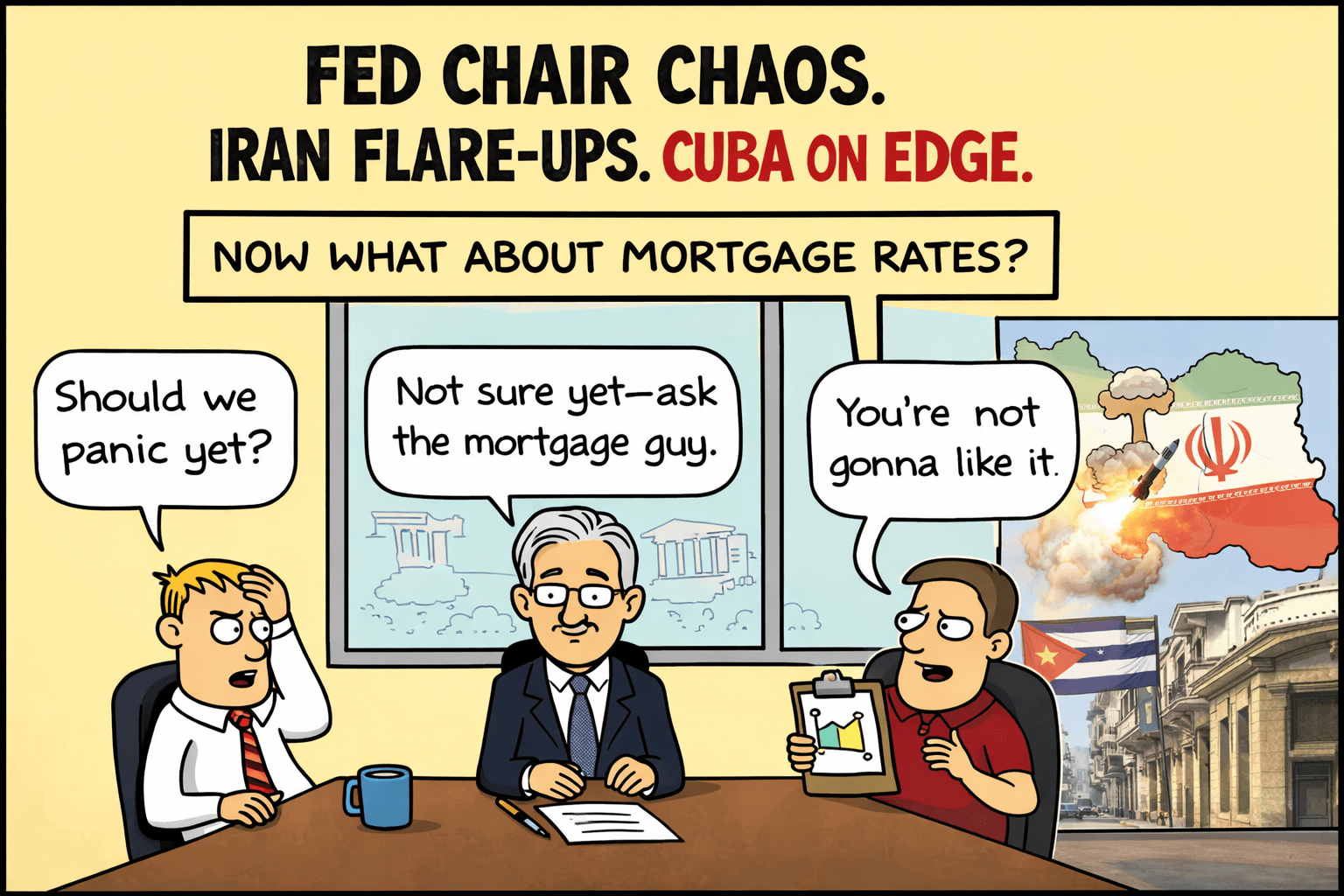
Even if you haven’t glanced at the news recently, you might feel like the world is doing a slow-motion juggling act with chainsaws. And that’s not wrong. Between the Federal Reserve leadership uncertainty, tension in Iran, and Cuba quietly being a wildcard, mortgage rates are watching this like a hawk… and so should you.
Powell, Warsh, and the FOMC Drama
Here’s the scoop: As you know, and many on the Red side have celebrated, Jerome Powell’s term as Fed Chair is set to end in May. But the new guy—Kevin Warsh—hasn’t been confirmed yet. Why? Because Senate politics are… well, Senate politics. Some Republican senators on the Banking Committee are holding their votes hostage over unrelated legal issues involving Powell. (chase.com)
Translation: Warsh can’t step in, Powell’s term as chair ends, but law allows him to stay on as “chair pro tempore.” So, he’s effectively saying, “I’ll hold the fort until you figure this out.”
Wait, What? Powell may not have to leave the chair position, even if he term is up?
Why does this matter? Because the Fed isn’t just some abstract bureaucracy. It sets interest rates, guides monetary policy, and steers inflation expectations. Any leadership vacuum—or even the hint of one—sends investors twitching. A Fed without a clear chair? That’s like driving a sports car with no steering wheel. You might still move forward, but it’s going to be messy.
The Confirmation Process, for the Curious
For context, here’s how a Fed chair normally gets installed:
- Presidential Nomination – The President selects a candidate (Trump did that in January), often from the current Board of Governors (but Warsh is not on the current Board of Governors).
- Senate Committee Review – The Banking Committee vets the nominee, asks tough questions, and puts them through a public grilling.
- Committee Vote – If approved, the nomination moves to the full Senate.
- Full Senate Confirmation – The Senate votes; simple majority needed. Only then does the new chair officially take over.
Right now, Warsh is stuck in step two, and Powell is likely to hold the chair pro tempore position – until things get figured out. Stability is preserved—for now—but the clock is ticking. If confirmation drags longer, market uncertainty grows, which has real consequences for borrowing costs.
Enter Iran (Because the Universe Loves Drama)
While we’re talking uncertainty, the market (again this article isn’t pro or anti red or blue, I just follow the color green… the color of money) seems to have gotten tired of the Trump Administration’s updates on the US/Isreal Iran War. “This will be over in 3 weeks” has been said before. And the question of “what does ‘over’ look like”? has yet to be answered.
When oil spikes, inflation often follows. Higher inflation makes the Fed less likely to cut rates—or could even push them to hike.
So even if Powell stays on temporarily, he’s now navigating the Fed through not just political uncertainty, but a geopolitical one too.
And Then There’s Cuba (The Silent Wildcard)
On March 30th, Trump announced “Cuba is Next”. (CNN.com) Cuba might not seem like a headline-grabber, but it’s quietly relevant. The country is grappling with US imposed fuel shortages, blackouts, and rising unrest, all while strengthening ties with countries like Iran and Russia. (reuters.com)
That’s not a global crisis on its own—but combine it with Middle East volatility, Fed leadership uncertainty, and inflation chatter? Suddenly, it’s part of a cocktail that makes investors nervous. Markets don’t like uncertainty, and mortgage rates react to uncertainty faster than a teenager checking TikTok.
So What Happens if the Fed Chair Isn’t Confirmed?
If Warsh isn’t confirmed by May—or even worse, if confirmation stalls indefinitely—Powell stays on temporarily. That’s good in the short term: continuity is maintained, markets get a familiar voice, and policy drift is minimized.
But it also keeps a cloud over long-term planning. Investors don’t know if the next Fed chair will be dovish, hawkish, or somewhere in the middle. That uncertainty can keep mortgage rates elevated because long-term bonds—which set the basis for mortgages—hate ambiguity more than most people hate traffic on I-5.
What It Means for Mortgage Rates
Here’s the bottom line:
- Short-term: Rates could benefit from a “flight to safety.” Investors might pile into Treasury bonds, which usually pushes mortgage rates down a touch.
- Medium-term: If Iran escalates, oil spikes, or Cuba destabilizes further, inflation risk rises. That keeps the Fed cautious about cutting rates—and mortgages might not drop as much as you’d like.
- Wildcard: Prolonged Fed chair uncertainty keeps markets jittery. Mortgage rates don’t like “we’ll see” situations.
So while we could see a temporary window of lower rates, it’s one to seize quickly. Because if the world decides to turn up the heat—Powell’s temporary stewardship, Middle East tension, and Cuba’s quiet chaos—rates could climb before anyone finishes their morning coffee.
The Takeaway
And now you know the answer of why – did mortgage rates go up by over half a percent inside of 3 weeks? Right now, mortgage rates are caught in a perfect storm: Fed leadership limbo, geopolitical tension, and inflation uncertainty. Markets are optimistic—but history tells us that optimism in a geopolitical + political blender rarely lasts. According to Google’s Gemini, a recession risk now lies at between 30-50% by this winter.
For borrowers, that means paying attention is worth your time. A small window could open for better rates—but if the global and political storylines keep escalating, that window might slam shut faster than you can say “chair pro tempore.”
I’ve been asked, how do rates get back to the mid to high 5%’s like they were in mid February? I have a one-word answer. Certainty.
Mortgage and bond rates hate the unknown. Bring back certainty, and we’ll get this 2026 housing a refi boom back on track.