The Fed Is Changing Guards — and Your Future Mortgage Rate Is About to Feel It
Dig in, in this 4 minute read and learn why Kevin Warsh might be influencing your future mortgage rate as Trump's pick to lead the Federal Reserve Board
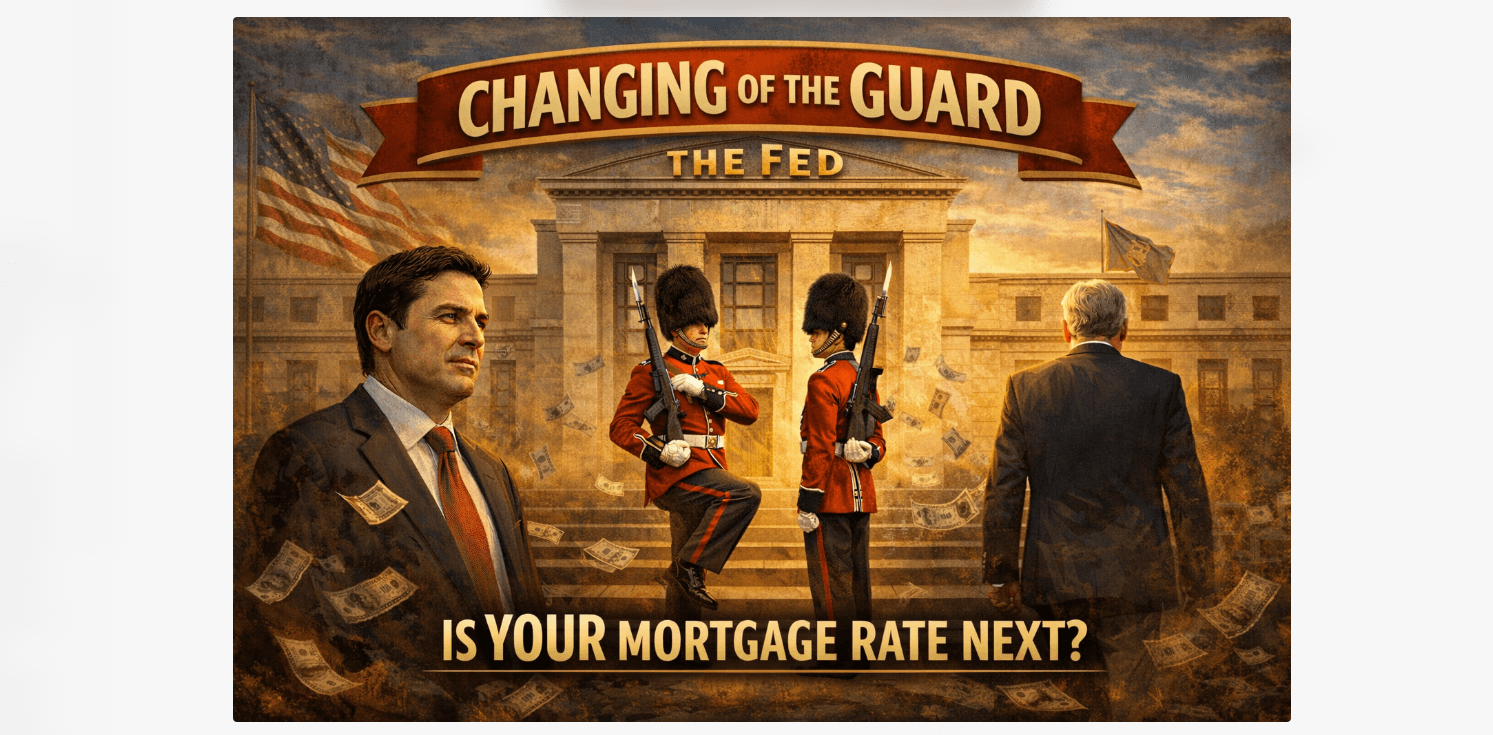
The Fed Is Changing Guards — and Your Future Mortgage Rate Is About to Feel It
President Donald Trump’s January 30, 2026 announcement that he plans to nominate Kevin Warsh to replace Jerome Powell as Chair of the Federal Reserve is a big deal — and not just inside Washington. It signals a potential shift in how the Fed thinks about interest rates, inflation, and its role in the economy.
Find a comfy spot, I’ll give you a quick “Federal Reserve 101” lesson and what this all really means behind the headlines that you’ve read (whether your source be NPR, CNN, or Fox News – as there have been different slants to this announcement) Warsh isn’t new to the Fed. Supporters see him as someone with deep institutional knowledge who could realign the Fed’s priorities. Critics, meanwhile, are watching closely to see just how dramatic a policy shift he might actually try to make.
None of this is final yet. Warsh still needs Senate confirmation, and politics are already complicating the process. Republican Senator Thom Tillis has said he doesn’t want the nomination to move forward until the separate investigation involving Powell is resolved, while Democrats have raised concerns about protecting the Fed’s independence from political pressure. Remember, the Fed isn’t supposed to be Blue or Red… they are supposed to be purely Green (the color of money).
Powell vs. Warsh: How Their Approaches Differ
Jerome Powell’s time as Fed Chair has been marked by caution. He’s leaned heavily on incoming data and has generally preferred to move slowly, especially when it comes to cutting rates. During the inflation surge of the early 2020s, Powell guided the Fed through a series of gradual rate hikes to cool prices — and even after inflation eased, he resisted moving too quickly in the other direction. Are we still on the runway from his soft-landing? It’s very ambiguous.
Warsh comes at this from a different angle. Earlier in his career, he was seen as a classic “hawk” — in that he believed it was government’s job to fight inflation. Lately, though, his tone has shifted. In public comments and in alignment with Trump’s economic goals, Warsh has been more open to cutting rates and has criticized the Fed for being too slow to ease policy. Essentially let capitalism handle pricing and inflation. Hands off the economy.
He’s argued that long-term productivity gains — especially from technology — could help keep inflation in check without the Fed needing to be overly restrictive. That’s why many observers now describe him as structurally hawkish but tactically dovish: disciplined about inflation in principle, but flexible in practice when conditions allow.
Hawks and Doves — In Plain English
When people talk about “hawks” and “doves” at the Fed, they’re really talking about priorities.
Hawks focus on inflation. They’re more willing to keep federal lending interest rates higher, even if that slows the economy, because they see price stability as the foundation of long-term growth.
Doves care more about supporting jobs and economic activity. They’re quicker to cut rates or provide stimulus, even if inflation hasn’t fully settled down yet.
These labels matter because the Fed has a dual mandate: keep inflation under control and support maximum sustainable employment. You can’t always do both perfectly at the same time (in fact, they usually work AGAINST each other), so where policymakers land on that spectrum influences everything from mortgage rates to stock prices.
How the Fed Actually Makes Decisions
One important thing to remember: the Fed Chair doesn’t act alone. Warsh, alone won’t change things.
Interest rate decisions are made by the Federal Open Market Committee (FOMC), which has 12 voting members. All 19 Fed leaders take part in discussions, but only 12 vote at any given meeting. The structure is designed to balance national oversight with on-the-ground regional perspectives. Warsh is only one of the 12 votes.
The FOMC: 2025 vs. 2026
Because of that rotation system, the makeup of the FOMC changes every year. Analysts track these shifts closely and often score members on a hawk-to-dove scale to get a sense of the committee’s overall lean.
The takeaway for 2026? Even with Warsh replacing a generally more dovish figure, the committee as a whole doesn’t swing dramatically in one direction. Some of the incoming regional Fed presidents are historically more hawkish, which helps offset the change at the top.
What does change is the range of views inside the room. The committee may become more divided, with stronger opinions on both ends of the spectrum. That can make consensus harder to reach and messaging trickier — something markets tend to notice.
What This Likely Means for Policy
Even if Warsh takes the chair, he won’t be able to single-handedly steer monetary policy. He’ll need to build agreement among the 12 voting members, and that naturally limits how aggressive any shift can be.
Most economists expect continuity rather than upheaval in 2026. A couple of rate cuts are possible, but far from guaranteed, especially with inflation still above the Fed’s 2 percent target and the labor market holding up reasonably well.
Where Warsh may leave the biggest mark is over the longer term — in how the Fed communicates, how it thinks about productivity and inflation, and how it manages its balance sheet. In that sense, he could end up acting as a bridge between markets eager for easier policy and a committee still wary of inflation risks.
Important, influential — but not all-powerful.
What This Means for Interest Rates and Housing
For anyone watching mortgage rates or thinking about buying or refinancing a home, the big question is simple: does Kevin Warsh at the Fed mean lower rates are coming?
The honest answer is: maybe — but don’t expect a sudden drop. My forecast remains on point, in that I believe summer will see rates at there lowest point of 2026 – and then by early winter we’ll likely see them rise back to where they are now.
Even with a chair who appears more open to easing, the Fed is unlikely to move aggressively. Inflation is still above the 2 percent target, and policymakers remain wary of cutting too fast and having to reverse course later. In addition, we are still waiting on a Supreme Court to give us a ruling on if the President can unilaterally issue tariffs without congressional approval.
For housing, this kind of environment tends to support stability rather than a boom. Slightly lower summer rates could help affordability at the margins and bring more buyers off the sidelines, but they probably won’t unleash a wave of refinancing or spark runaway home-price growth. Supply constraints in the Northeast, local market dynamics here in the Northwest, and household income growth will continue to matter just as much for the national housing market — if not more — than who sits in the Fed chair.
In short, Warsh’s nomination may tilt the conversation toward easing sooner rather than later, which is directionally positive for housing. But the Fed is still driving with one foot on the brake, and markets know it.
And unfortunately, politics still play a roll in the confirmation of getting Kevin Walsh in the seat. That said, of the current list of nominees that I’ve researched, Walsh seems to be the most tolerated by much of the left.
BOTTOM LINE:
I’m at best, with this news, I’m still expecting rates to be in the mid 5%’s come July. The Portland Metro will be the strongest buyers side market that we’ve seen in years – that will spur on activity – but home prices will likely stagnate (which isn’t a bad thing – as that helps the affordability equation).
#ChangingOfTheGuard
#FederalReserve
#InterestRates
#MortgageRates
#HousingMarket
#MonetaryPolicy
#FedWatch
#Inflation
#EconomicOutlook
#FOMC
#RealEstate
#HomeBuying
#HousingAffordability
#MortgageNews
#MarketUpdate
#RateCuts
#EconomicPolicy
#WallStreetAndMainStreet
#MoneyMatters