People Placing Bets on Mortgage Rates May Know Something that the Industry Doesn't
Polymarket and Kalshi might have something to say about the housing market and mortgage rates. I'm starting to listen.
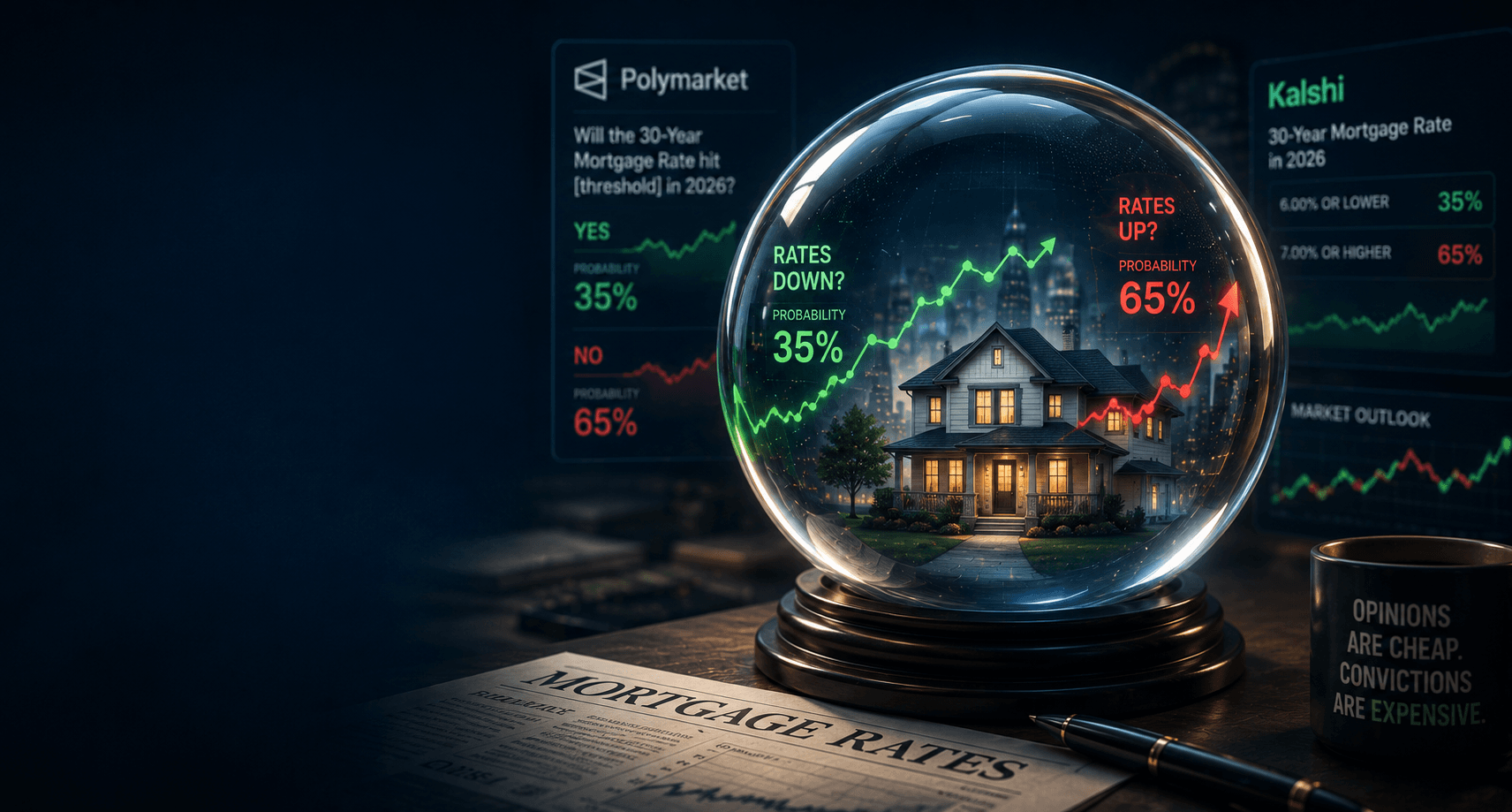
What if the best mortgage rate forecast of 2026 isn't sitting in an economist's spreadsheet... but on a website where strangers are literally betting on it? Every mortgage professional has been asked the same question: "Where are rates headed?" My answer lately has been different: "Let's ask the market."
My Bet: Prediction Markets Might Know Where Mortgage Rates Are Headed
I have a confession. My name is Eric Simantel, and I am a super nerd. Like the kind that stays up late and compares a post-Eisenhower economy to economic Big Beautiful Bill models. Needless to say, I also spend a lot of time reading mortgage rate forecasts. Probably too much time.
Every month or quarter, the same thing happens. The big banks release their mortgage rate predictions. Economists build their models. Housing analysts weigh in. Financial media asks the question everyone wants answered:
"Are rates going up or down?"The subtext being, should I wait to buy, sell, or refinance my home. And then reality happens. Inflation surprises. Employment data changes the Federal Reserve's path. Oil prices move. A geopolitical event nobody saw a month ago becomes the biggest story in the world.
Suddenly, those very confident forecasts don't look quite as confident.
Which leads me to a question:
What if we spent more time listening to the people who are willing to put money behind their opinions?
That is exactly why I've become fascinated with prediction markets. They are astock market for future events:
If you've never visited websites like Polymarket or Kalshi, here's the simple explanation. They are betting websites where people buy and sell contracts based on future outcomes. Instead of buying shares of Apple or Microsoft, participants are buying and selling probabilities.
- Will the Federal Reserve cut rates?
- Will inflation exceed a certain level?
- Will the average 30-year mortgage rate hit a specific number (the hyperlinks above take you to those respective betting pages)?
The price tells the story. A contract trading at $0.70 suggests the market believes there is roughly a 70% probability that an event happens. A "No" contract trading at $0.85 suggests the market believes there is roughly an 85% chance that event does not happen.
It is not one person's opinion. That's the really cool part. It is thousands of people constantly updating their beliefs BUT with real money attached. And that is what makes it fascinating. Whether its a gallon of gas, a box of cereal, the 10 year treasury rate - today's prices are based on the beliefs of tomorrow.
So what are prediction markets saying about mortgage rates?
I pulled up two markets that caught my attention. The first was Polymarket's market asking: "Will the 30-year mortgage rate hit [specific threshold] in 2026?" The second was Kalshi' mortgage rate market, which allows traders to buy contracts based on where mortgage rates will move. At the time I am writing this:
- Polymarket traders are pricing the probability of68%that mortgage rates hit7%.
- Kalshi traders are pricing the probability of72%for mortgage rates reaching6.8%.
Put simply:
The market is not predicting a return to the historic lows of the pandemic era or even rates in the 5%’s for that matter. It is also not saying 7%+ mortgage rates are guaranteed. What it is saying is that the probability of rates remaining elevated is much higher than many people casually assume.
And that matters. Because I think there is still a lot of conversation in housing that assumes mortgage rates are simply "waiting to fall." Maybe. But the people putting money behind their opinions are telling a more cautious story.
Opinions are cheap. Convictions are expensive.
Here is the part I find most interesting. Economists make forecasts. Prediction market participants make bets. Those are different. An economist can publish a forecast, revise it six months later, and the original prediction often disappears into the internet. A trader who buys the wrong prediction feels that mistake immediately.
The market does not care about credentials. It does not care about job titles. It does not care how many interviews someone has done on television (if you work in the industry, I’m sure you know who I’m referring to! 😊).
It asks one question:
"How much are you willing to risk that you are right?"
There is something powerful about that.
Does this mean prediction markets are smarter than economists?
No. And that is actually the point. Prediction markets are not a replacement for economists. BUT, if the prediction market is able to show how the people buying and selling stocks and bonds feel - they are putting a compass on the direction they feel the market is headed. And that is incredibly important. There is literally hundreds of thousands of dollars being bet on this.
Researchers have studied prediction markets for decades because they do something economists value: they aggregate information.
Instead of relying on a handful of experts, prediction markets combine the views of thousands of participants who each bring their own knowledge, research, and perspective. In many cases, prediction markets have performed remarkably well compared with traditional forecasting methods, particularly when there is enough participation and liquidity.
They are not perfect. Neither are economic forecasts. The difference is that prediction markets update continuously. They are living breathing constantly updated forecasts.
Maybe the future belongs to probabilities.
One thing I appreciate about prediction markets is that they force humility. A traditional forecast says: "Mortgage rates will be 6.25% next year."
That sounds precise. But is it really?
A prediction market says:
"Based on everything we know today, there is a certain probability that rates reach this level." That feels much more honest. The future is not a single number. It is a range of possibilities.
I am not replacing economists with prediction markets. I still watch inflation. I still watch employment. I still follow Federal Reserve decisions. I still spend a ridiculous amount of time watching the 10-year Treasury because, ultimately, mortgage rates are driven by the bond market.
But I am adding prediction markets to the toolbox. Because in a world full of opinions, forecasts, and predictions... There is something refreshing about a place where people have to attach a price to their opinion. Maybe prediction markets won't tell us exactly where mortgage rates are headed.
But they might tell us something even more valuable:
What thousands of people, collectively, believe is most likely. And in an industry built around helping people make decisions about the future... That is a signal worth paying attention to.