Oregon is #1! Wait, is that Good?
Oregon is #1 in the NATION in the percentage of home listings that have had price reductions. Is it time for buyers to show up or hunker down?
One of the biggest mistakes people make when following the housing market is assuming that national real estate headlines tell us what's happening in our own backyard. They don't. Real estate has always been local, and right now, Oregon is proving just how different one housing market can be from the rest of the country.
While national economists debate whether we're in a buyer's market, a seller's market, or somewhere in between, Oregon has decided to take the lead. And when I say lead, I meanwe're NUMBER ONE in the nation for the percentage of homes with price reductions.Not exactly the kind of championship we're accustomed to celebrating, but for homebuyers, it's pretty darn exciting.
According to October 18, 2026, data from Parcl Labs,53% of all active home listings in Oregon have experienced a price reduction, compared with the national average of 44%. Colorado comes in second at 52.3%, followed by Washington at 50%. Even California, where housing affordability has been a challenge for decades, sits well below Oregon at 39.3%.
I've been writing for more than a year about why I believed Oregon, and particularly the Portland metropolitan area, was headed toward a significant housing market correction. Slowing population growth, declining affordability, elevated mortgage rates, and changing employment trends were all pointing in the same direction. The question was never whether these forces would influence our market, but when buyers would finally regain the negotiating power they'd lost.
Well, folks, we're here. And the numbers are increasingly supporting what I've been forecasting.
Oregon Has a Demand Problem, Not Just a Mortgage Rate Problem
Remember the housing frenzy of 2020 and 2021? Californians were discovering they could sell their homes, move to Oregon, work remotely, and still have enough money left over for a new Subaru and a lifetime supply of Patagonia jackets. Historically low mortgage rates, combined with population growth, created extraordinary demand for housing.
But something fundamental has changed. According to the U.S. Census Bureau, Oregon's population grew just 0.9% between April 2020 and July 2025. Portland's population actually declined approximately 2.7% during that same period. Meanwhile, the Portland Metro Chamber reported that our region lost approximately 8,800 jobs in 2025, ranking fourth-worst among major metropolitan areas for job losses.
Here's something I found particularly interesting. The Portland region experienced approximately 13,900 more births than deaths in 2001. By 2024, that number had dropped to just 3,400. That's a roughly 76% decline in natural population growth.
Why does this matter? Because housing demand isn't created by mortgage rates alone. It's created by people. People moving here, starting families, changing jobs, and needing places to live. When population growth slows dramatically and employment opportunities weaken, the number of buyers competing for homes can shrink. Yet the homes are still sitting there, waiting for someone to purchase them.
That's a supply-and-demand equation that doesn't favor sellers.
Price Reductions Are Only Half the Story
Here's where things get really interesting. According to September 2026 RMLS data, Portland-area housing inventory reached 4.2 months, compared with 3.8 months in August. Homes were spending an average of 68 days on the market, while pending sales were down nearly 18% compared with September 2025.
But if you look exclusively at median home prices, you might wonder what all the excitement is about. Depending on the reporting period and data source, Portland's median closed-sale price has remained relatively stable or experienced relatively modest declines.
How can that be when more than half of Oregon's active listings have experienced price reductions?
Becausea price reduction isn't necessarily the same thing as a decline in home value.If someone lists their $550,000 house for $625,000, then eventually reduces it to $550,000, they haven't necessarily lost $75,000 in equity. They've simply discovered that buyers aren't willing to pay yesterday's fantasy price.
But actual closed-sale prices are beginning to show weakness as well. Redfin reported Portland's median sale price at approximately $518,253 for the three months ending September 2026, down 2.2% from the previous year. That's an important distinction because those are actual transactions, not just sellers adjusting their asking prices.
And I believe there's more to come.
The Hidden Discounts That Don't Show Up in Home Prices
Here's one of my favorite statistics from researching this market. According to Redfin,54.5% of Portland-area homebuyers received seller concessionsduring the three months ending August 2026. Nationally, that number was 44.7%.
That's a huge difference, and it's something that doesn't necessarily show up when you're reading about median home prices.
Imagine purchasing a $550,000 home and negotiating a $15,000 seller credit toward closing costs or a mortgage rate buydown. The home still records as a $550,000 sale, but you've received $15,000 in additional financial benefits that weren't reflected in the reported purchase price.
As a mortgage broker, I see firsthand how meaningful these concessions can be. A seller credit can reduce the amount of money buyers need at closing, or potentially help them secure a lower mortgage rate and monthly payment. These are negotiating opportunities that were practically nonexistent during the bidding wars of 2021.
The buyers haven't just returned to the negotiating table. They're finally getting to order off the menu.
Something Else Is Happening That Could Make This Correction More Interesting
While researching Oregon's housing market, I came across another statistic that caught my attention. According to the Oregon Governor's Office, housing starts increased 11.3% during the first half of 2026 compared with the previous year. Nationally, housing starts declined 1.3%.
Think about that for a moment. Oregon is experiencing slowing population growth, weaker employment conditions, and increasing price reductions, yet statewide housing construction is moving in the opposite direction from the national trend.
Now, not all of that new construction is in Portland, and construction starts don't immediately translate into available homes. But it raises an interesting question: What happens when additional housing supply enters a market where demand isn't growing the way it once did?
My suspicion is that sellers, including builders, will need to become increasingly competitive. And that's another reason I believe we're not necessarily finished with this housing market adjustment.
Affordability: Could Monthly Payments Fall Below 2023 Levels?
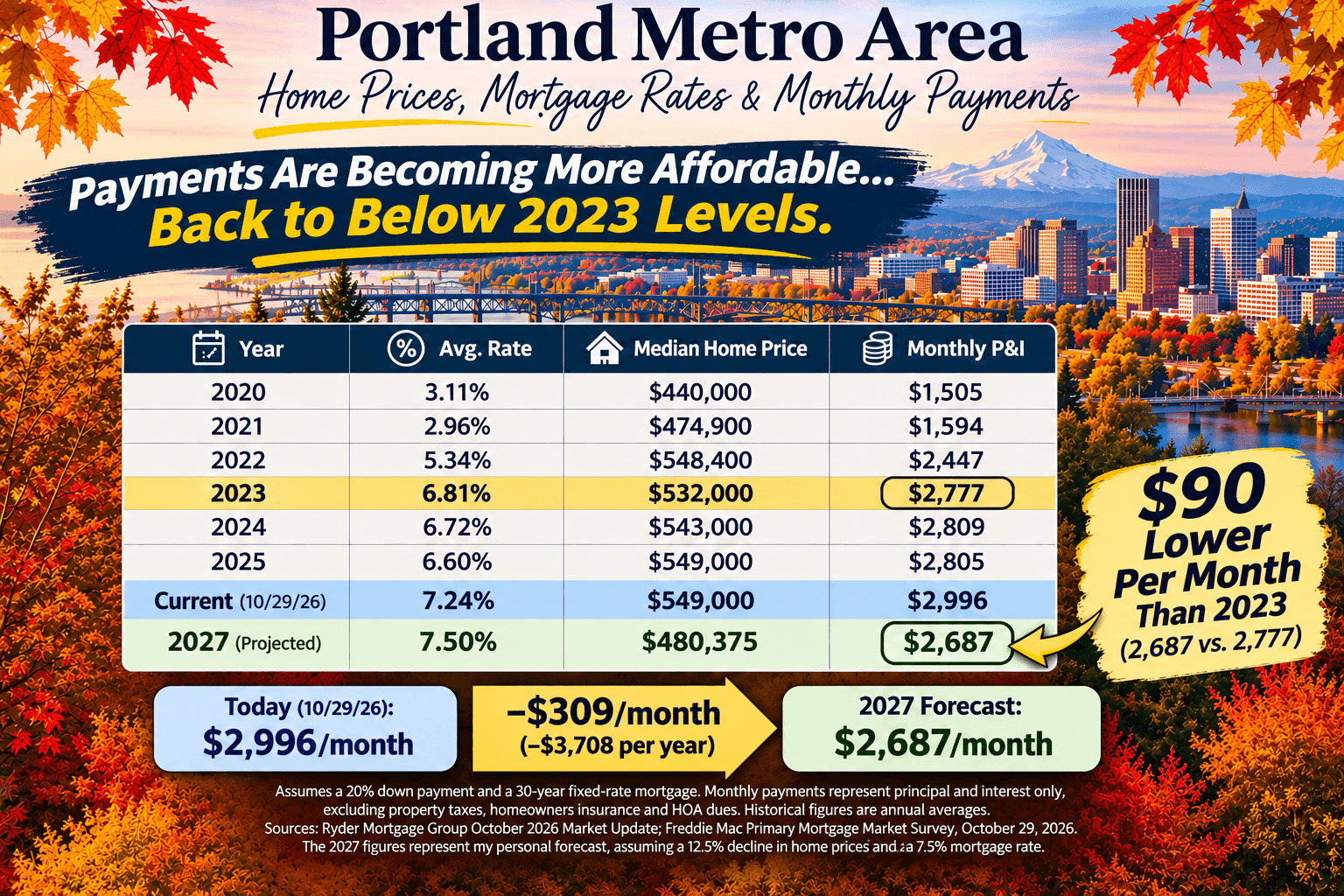
Now here's the part of my forecast that I find particularly exciting. Everyone keeps talking about mortgage rates and how we need them to come down to make housing affordable again. But what if we're looking at the wrong side of the equation?What if home prices fall enough that affordability improves even while mortgage rates remain elevated?That's exactly what I've been forecasting, and the numbers are worth a closer look.
According to Freddie Mac's October 29, 2026 survey, the average 30-year fixed mortgage rate was 7.24%. Using a Portland-area median home price of $549,000 and a 20% down payment, that translates into a monthly principal-and-interest payment of approximately $2,996. Now, let's jump forward to my 2027 forecast. If home prices decline 12.5% to approximately $480,375, even with mortgage rates increasing to 7.5%, that same buyer would have a monthly payment of approximately $2,687.
That's a savings of $309 per month, or $3,708 per year, compared with today's payment, despite mortgage rates actually increasing.But here's the part I find even more interesting. In 2023, the average monthly principal-and-interest payment on a median-priced Portland-area home was approximately $2,777. Under my forecast, we'd be looking at payments roughly $90 LOWER than we experienced in 2023. That's right. We could climb into our housing affordability time machine and travel backward several years without needing mortgage rates to return to 3%. We'd simply need home prices to become more reasonable.
My Forecast for 2027 Hasn't Changed
I've previously written that I believe Portland-area home prices could decline approximately 10% to 15% by early 2027. That's my forecast, not an industry consensus, and the full decline certainly hasn't happened yet. But the underlying conditions supporting that prediction have become increasingly apparent.
I'm also not convinced that mortgage rates are coming to the rescue anytime soon. I've been forecasting the possibility of rates remaining in the 7% to 8% range during 2027, with 7.5% as my central estimate. If mortgage rates remain elevated, home prices may need to do more of the heavy lifting to restore affordability.
And here's the part that should get buyers excited. A lower purchase price can offset some of the pain of a higher mortgage rate. Unlike a mortgage rate, which may offer an opportunity to refinance later, the price you pay for a home establishes your starting mortgage balance and equity position.
I would much rather help someone negotiate a great purchase price today than encourage them to overpay for a home simply because someone on television predicts lower mortgage rates next spring.
The Bottom Line: Oregon Is Leading the Nation, and Buyers Should Be Paying Attention
For more than a year, I've been discussing the warning signs in Oregon's housing market. Slowing population growth, deteriorating affordability, weakening employment, and increasing inventory weren't isolated statistics. They were pieces of a much larger puzzle.
Today, we're seeing those pieces come together. Oregon leads the nation in the percentage of active listings with price reductions, Portland buyers are negotiating concessions at rates well above the national average, and actual closed-sale prices are beginning to soften.
Does that mean every Oregon neighborhood is experiencing the same conditions? Absolutely not. Desirable homes priced appropriately can still sell quickly, and some neighborhoods remain more competitive than others. But the broader direction of our market is becoming increasingly difficult to ignore.
I've been forecasting a buyer's market in Oregon, and that's exactly the direction we've been moving.Whether the full price correction I anticipate arrives by early 2027 remains to be seen, but buyers already have opportunities they haven't enjoyed since 2008/09.
So the next time you hear a national housing expert explain what's happening to real estate across America, remember that Oregon is writing its own story. And right now, we're leading the nation. For once, being number one might actually save you money.
#OregonHousingMarket #PortlandRealEstate #OregonRealEstate #PortlandHousingMarket #BuyersMarket #HomePriceReductions #HousingAffordability #MortgageRates #HousingMarketForecast #RealEstateTrends #HomeBuying #PortlandMetro #MortgageBroker #RyderMortgageGroup