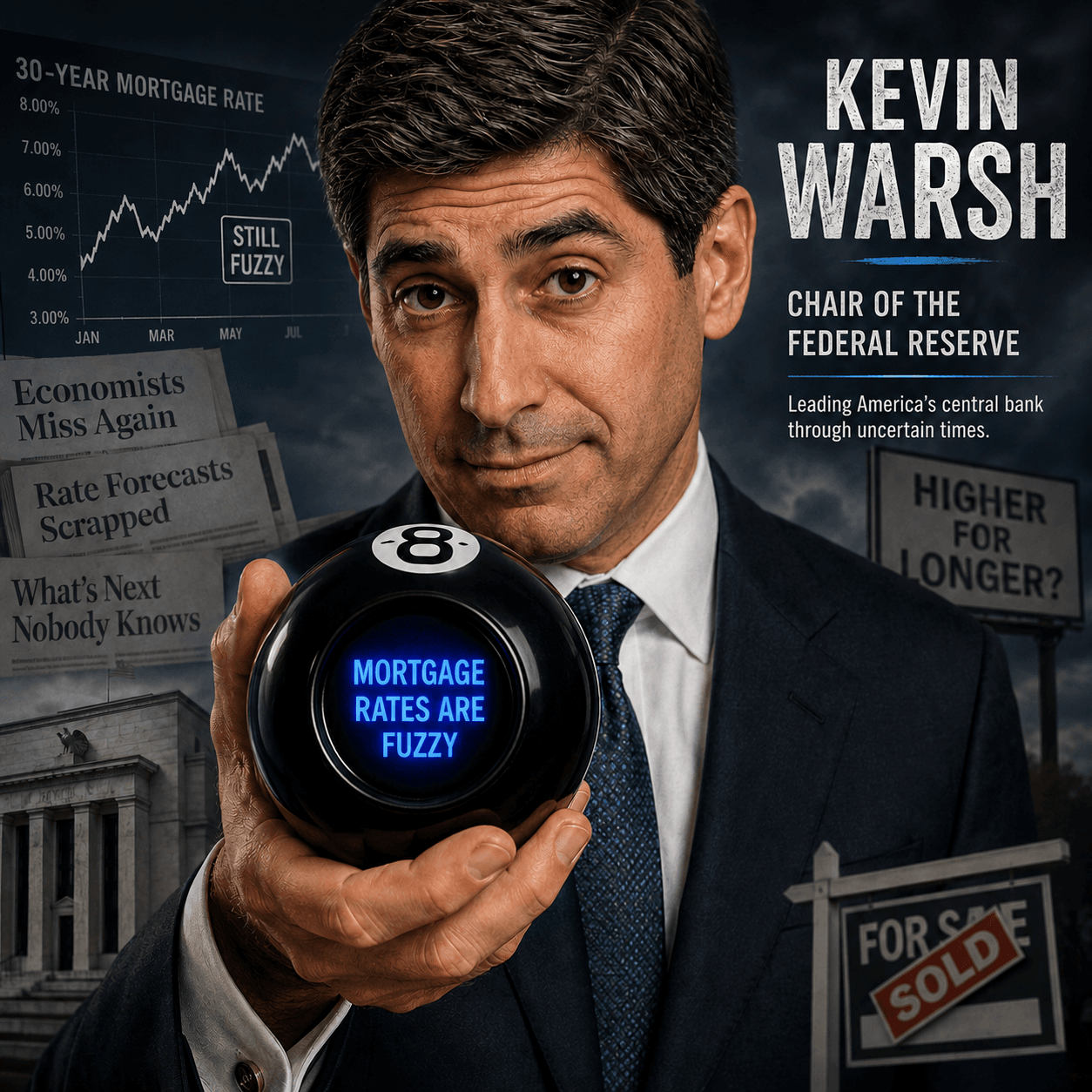
Kevin Warsh is officially in. So why haven’t we seen the Economic version of the “Usual Suspects” (cough, cough—Wells Fargo, the National Association of Realtors, Bank of America, Mortgage News Daily, CNBC, Fox News, etc.) jump in with updates or thoughts on the future of the federal funds rate, bonds, or the Mortgage market? Twelve months ago these economists could not stop talking about falling interest rates. Every major bank had a prediction. CNBC panels confidently discussed “the coming rate-cut cycle.” Mortgage lenders talked about refinance booms returning. Housing analysts forecasted 30-year mortgage rates drifting comfortably back into the fives. The tone wasn’t cautious — it was almost inevitable. Inflation was cooling, the Federal Reserve appeared finished hiking, and Wall Street was ready to move on from the chaos of the previous two years. Heck, even I called for about a full percentage point rate decline between Winter of 2025 and the Summer of 2026 because of a change of guard at the Federal Reserve, lowering inflation, and the thought that the Treasury would end their 3-year run of selling of Mortgage Backed Security Bonds. Then something strange happened. The economy refused to cooperate with the script. Today, many of those same economists have gone noticeably quiet. The bold predictions have softened into vague probability ranges and carefully hedged statements that are too vanilla to care about. Instead of confidently saying where mortgage rates will be six or twelve months from now, analysts now sound like weather forecasters tracking a hurricane that keeps changing direction overnight. Nobody wants to plant a flag in the ground anymore because the ground itself keeps moving. And honestly, that silence may be the most honest thing economists have done in years. The problem is not that economists suddenly became less intelligent. The problem is that the economy itself has become psychologically unstable in ways traditional models struggle to explain. For decades, economists operated under the assumption that markets behaved mostly rationally. Inflation moved in predictable cycles. The Federal Reserve adjusted rates. Consumers reacted accordingly. Bond markets followed a relatively orderly rhythm. That rhythm is gone. Take mortgage rates, for example. Last year, the overwhelming consensus was that rates would gradually decline as inflation cooled. On paper, the logic made sense. Inflation had fallen from its post-pandemic highs. The Fed was signaling eventual cuts. Historically, that combination should have pushed mortgage rates meaningfully lower. After a good run in the spring, as we enter the summer — mortgage rates have risen almost ¾ of a full percentage point. Why? Because economists underestimated something bigger than inflation itself: distrust. Bond markets no longer fully trust that inflation is truly dead. Investors look around and still see massive government spending, enormous federal deficits, stubborn wage pressure, rising insurance costs, geopolitical instability, and energy markets capable of exploding upward overnight. In other words, the economy still feels inflationary even when the headline numbers temporarily cool. That matters because mortgage rates are not controlled directly by the Federal Reserve. They are controlled by bond investors trying to predict the future purchasing power of money over the next thirty years. And right now, those investors are nervous. And perception is controlling the markets more so than reality. As you can tell, this is where the old economic playbook begins to break down. For years, Americans were taught a simple formula: if the economy weakens, rates fall. But the modern economy may no longer work that cleanly. What happens if economic growth slows while inflation remains sticky? What happens if gas prices spike because of geopolitical fears? There is a growing fear on my end that there may be another “COVID - Toilet Paper Event.” The simple fear of a gas shortage may indeed be the catalyst that causes a gas shortage. What happens if the government keeps issuing trillions in debt while investors begin demanding higher yields to finance it? Suddenly, the traditional assumptions stop working. And nowhere is that fear more visible than in the energy market. The Iran conflict has sent gasoline prices surging — even though only 20% of the world’s supply comes out of the Strait of Hormuz and the United States exports more than we keep for ourselves. Economists understand that modern inflation is not just mathematical anymore — it is psychological. Consumers see gas prices every single day. They react emotionally to them. Businesses react emotionally to them. Markets react emotionally to them. The COVID toilet paper shortage exposed something uncomfortable about modern economies: perception itself can become economic reality. There was never truly a long-term shortage of toilet paper production. There was a shortage of public confidence. People panicked, overbought, emptied shelves, and created the very crisis they feared. Gasoline markets could behave the same way. If consumers suddenly believe oil prices are heading dramatically higher, behavior changes immediately. People top off tanks constantly. Traders front-run shortages. News coverage amplifies fear. Prices jump not only because of actual supply constraints, but because everyone begins behaving as though shortages already exist. And this is where the bond market enters the story. A sharp rise in gas prices does not just hurt consumers at the pump. It infects the entire inflation outlook. Shipping costs rise. Airline costs rise. Food costs rise. Construction costs rise. Businesses pass expenses along. Workers demand higher wages. Inflation expectations become embedded psychologically across the economy. Bond investors know this. So even if the Federal Reserve eventually cuts rates, long-term yields — and mortgage rates — may not cooperate. In fact, they could stay elevated or even rise if investors believe inflation will reaccelerate. That possibility would have sounded absurd to many analysts just a few years ago. Today, it feels entirely plausible. And it actually happened in the 1970s under the actions of the Federal Reserve. If you want some additional reading, copy and paste “Tell me about the ‘Arthur Burns / 1970s mistake and fear that still hangs over central banking” into your ChatGPT prompt. Are we in that similar situation? This is why economists sound less certain now than they did a year ago. They are realizing that the economy has become less mechanical and far more emotional. Traditional forecasting models are built around historical relationships and rational responses. THIS YEAR’s market seems to be driven by narratives, fear, politics, debt levels, social media amplification, geopolitical tension, and public psychology all feeding off one another simultaneously. In other words, economists are no longer simply trying to predict inflation or Federal Reserve policy. They are trying to predict human behavior under uncertainty. And that is a much harder game. The uncomfortable truth is that nobody really knows what “normal” interest rates look like anymore. The ultra-low-rate world of 7–8 years ago now feels less like the norm and more like a temporary financial hallucination created by globalization, cheap energy, low inflation, and massive central bank intervention into a COVID economy. Today’s economy looks very different. Debt is larger. Inflation risks are higher. Geopolitical instability is constant. And consumers themselves are more financially and emotionally reactive than many experts previously assumed. So the reason economists have become quieter is not because they stopped forecasting. It is because they finally understand how fragile the system actually is. And once you see that fragility clearly, certainty becomes much harder to sell. Lastly, please note that I kept politics out of this conversation. I’ll continue to say mortgage rates don’t care if a Democrat or Republican is in office. They aren’t blue or red — mortgage rates are green… they follow the scent of money. Until we get past Iran, the Magic 8 Ball is saying “Mortgage Rates are Fuzzy.” #MortgageRates #InterestRates #HousingMarket #RealEstate #MortgageIndustry #Refinance #HousingAffordability #EconomicOutlook #MacroEconomics #Inflation #InflationExpectations #BondMarket #TreasuryYields #FederalReserve #FOMC #RateHikes #RateCuts #FinancialMarkets #EconomicUncertainty #MarketVolatility #Geopolitics #OilPrices #EnergyMarkets #ConsumerBehavior #HousingFinance #30YearMortgage #EconomicForecast#MortgageRates #InterestRates #HousingMarket #RealEstate #MortgageIndustry #Refinance #HousingAffordability #EconomicOutlook #MacroEconomics #Inflation #InflationExpectations #BondMarket #TreasuryYields #FederalReserve #FOMC #RateHikes #RateCuts #FinancialMarkets #EconomicUncertainty #MarketVolatility #Geopolitics #OilPrices #EnergyMarkets #ConsumerBehavior #HousingFinance #30YearMortgage #EconomicForecast |